



Design Extraordinary Places, Operate Them Forever.
A decade of permanent installs
The content and control platform for permanent installations.
Design, operate, and monitor dynamic lighting and media experiences for years, from any browser.
The clients and partners we build with.
-

-

-

-

-

-

-

-

- Charcoalblue
What is Lightpath OS
What is Lightpath OS?
Lightpath OS is a web-based platform for designing, operating, and monitoring dynamic lighting and media experiences. Everything about it is built for permanence: installs that run for years and pass from the team that builds them to the people who run them every day.
Content management, real-time generative visuals, fleet-wide monitoring, and intuitive scheduling, all in one interface. Accessible from a browser, phone, or any internet-connected device.
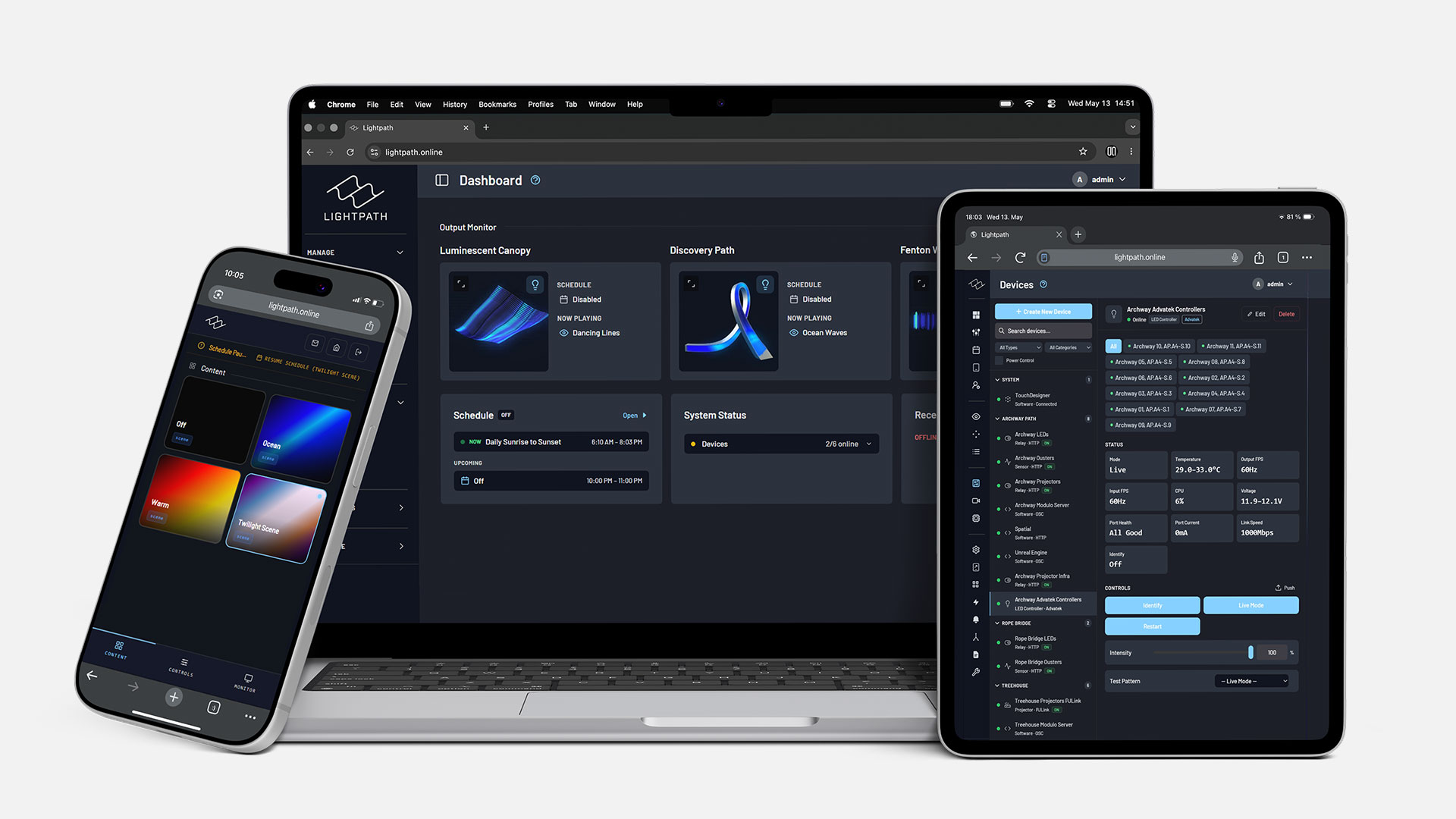
The platform
One platform, end to end.
Role-based access control means each user sees exactly what they need and nothing more — from the full developer toolset to a one-button exec view.
Create
Author content live in the browser: real-time pre-vis, brand palettes, prompted AI generations.
- Live generative sources: stream generative visuals into the browser; tune any exposed parameter live, with real-time pre-vis.
- Your media, your brand: upload video files or load streams from NDI and Spout; save exact brand palettes and restyle any Look in seconds.
- AI Studio: prompt new content for the install, real-time on the fly or as offline high-quality video.
Manage
Daily control and scheduling: looks, scenes, and schedules that run for years.
- Dashboard: every device's health, the current schedule, what's playing now, and recent alerts, at a glance.
- Controller: assign Looks to Outputs, recall Scenes across the install, sequence Playlists.
- Schedule: intuitive calendar based scheduling for content and automations, with astronomical sunrise and sunset triggers per fixture.
- Kiosk: a locked-down tablet or wall-mounted browser with only the buttons the client needs.
Integrate
Devices, feeds, and alerts: one hub speaking the protocols you already use.
- Devices: control and monitor anything from a single hub.
- Alerts: multi-condition logic; notify by Slack, Telegram, or email.
- NDI feeds: pull in a camera on the output to verify the real-world result.
- Actions: fire many commands at once, from a calendar event or the kiosk.
Build
The developer layer: outputs, plugins, and APIs for fully custom installs. Build whatever you need — interactivity, complex 3D pixel mappings, custom sources and effects.
- Outputs as TOX: each output is a TouchDesigner component, templated or your own.
- Auto parameter discovery: named pages expose parameters to the interface automatically.
- Plugins: read sensors, hit APIs, and generate content as system, source, or effect plugins.
- Multi-machine rendering: split intensive projects across machines, kept in sync.
Proactive monitoring
Know the moment something's wrong.
Every device watched continuously, alerts that fire on real problems, and backup mode that keeps the space live.
Explore Monitoring & Telemetry →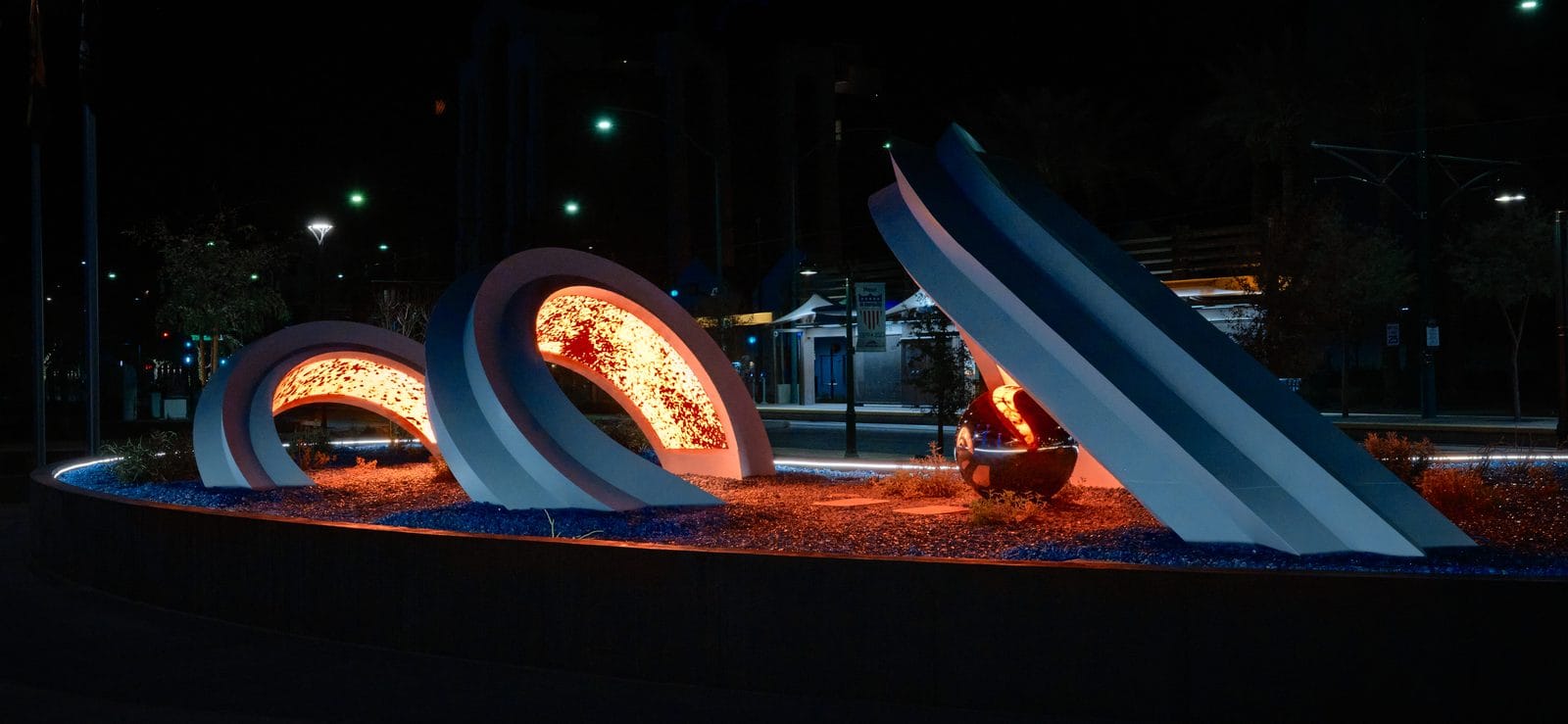
Interoperability
Works with the tools you already use.
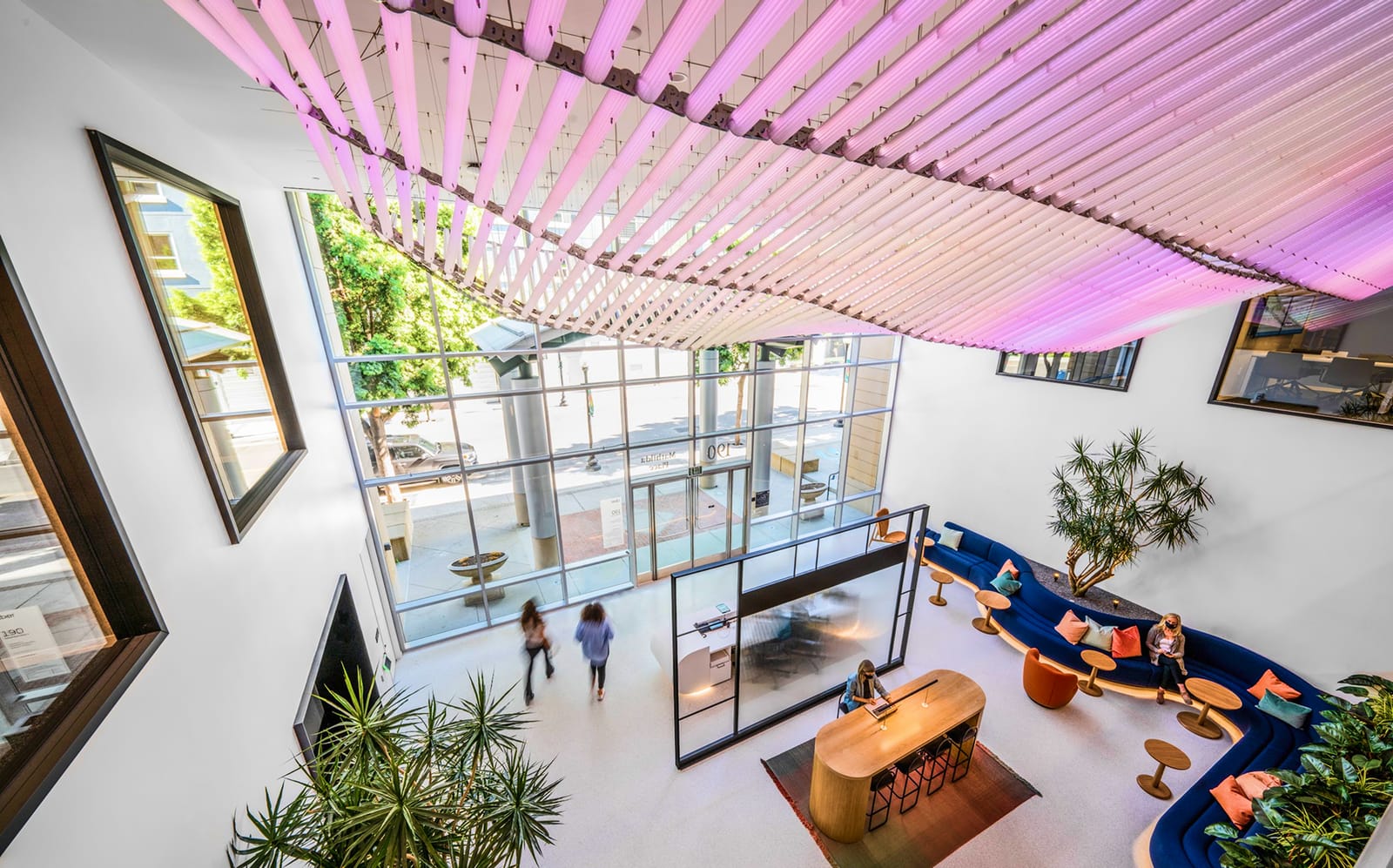
Modular by design: run the whole stack on Lightpath OS, or just a few roles alongside the software you already trust. It speaks OSC, HTTP REST, Art-Net, sACN, NDI, Spout, PJLink, Socket.IO, and more.
- ISAAC
- Advatek
- TouchDesigner
- Unreal Engine
- Pixera
- Q-SYS
- Lutron
- Crestron
Case study
Interactive projection, lighting, and spatial sound, as one experience.
The Lagunitas Experience is a permanent narrative-driven installation in Northern California: projection, architectural lighting, and 3D spatial audio, all real-time interactive, driven by live LiDAR and sensor data, all orchestrated by Lightpath OS. It demonstrates how Lightpath OS operates at scale, sitting at the heart of an ecosystem of other best-in-class systems. A team relies on Lightpath OS to keep the installations running at 100% year-round.
The stack, and how it fits together
- Lightpath OS: pixel mapping, orchestration, and the control UI. The brain of the install.
- Unreal Engine: real-time rendering.
- Modulo Pi: projection mapping.
- Spatial Sound: 3D multi-channel audio.
- TouchDesigner: ingests and processes live Ouster LiDAR feeds into interactive, generative content, with Lightpath OS coordinating sensor tracking across Unreal, Modulo Pi, and TouchDesigner.
In daily operation
Monitored end to end
60+ devices are monitored with alerts, so problems get caught before anyone notices.
Verify mapping remotely
a live feed of the projection mapping streams straight to the browser so the operators can check the real-world results remotely.
On-site control
an on-site iPad runs the interface for staff.
The Lagunitas Experience, a permanent outdoor installation in Northern California.