Integration
Lightpath OS × TouchDesigner
Turn any TouchDesigner project into a permanent, operable install. Lightpath OS wraps TouchDesigner in everything a permanent install needs: handoff, a browser UI, scheduling, and monitoring.
The split
Who does what.
-
You build only what is unique to your install in TouchDesigner: patterns, outputs, sensor logic.
-
Lightpath OS provides the entire operational layer on top: UI, scheduling, monitoring, content, and access.
The connection
How it works — the .tox contract
- 01
Outputs are destinations
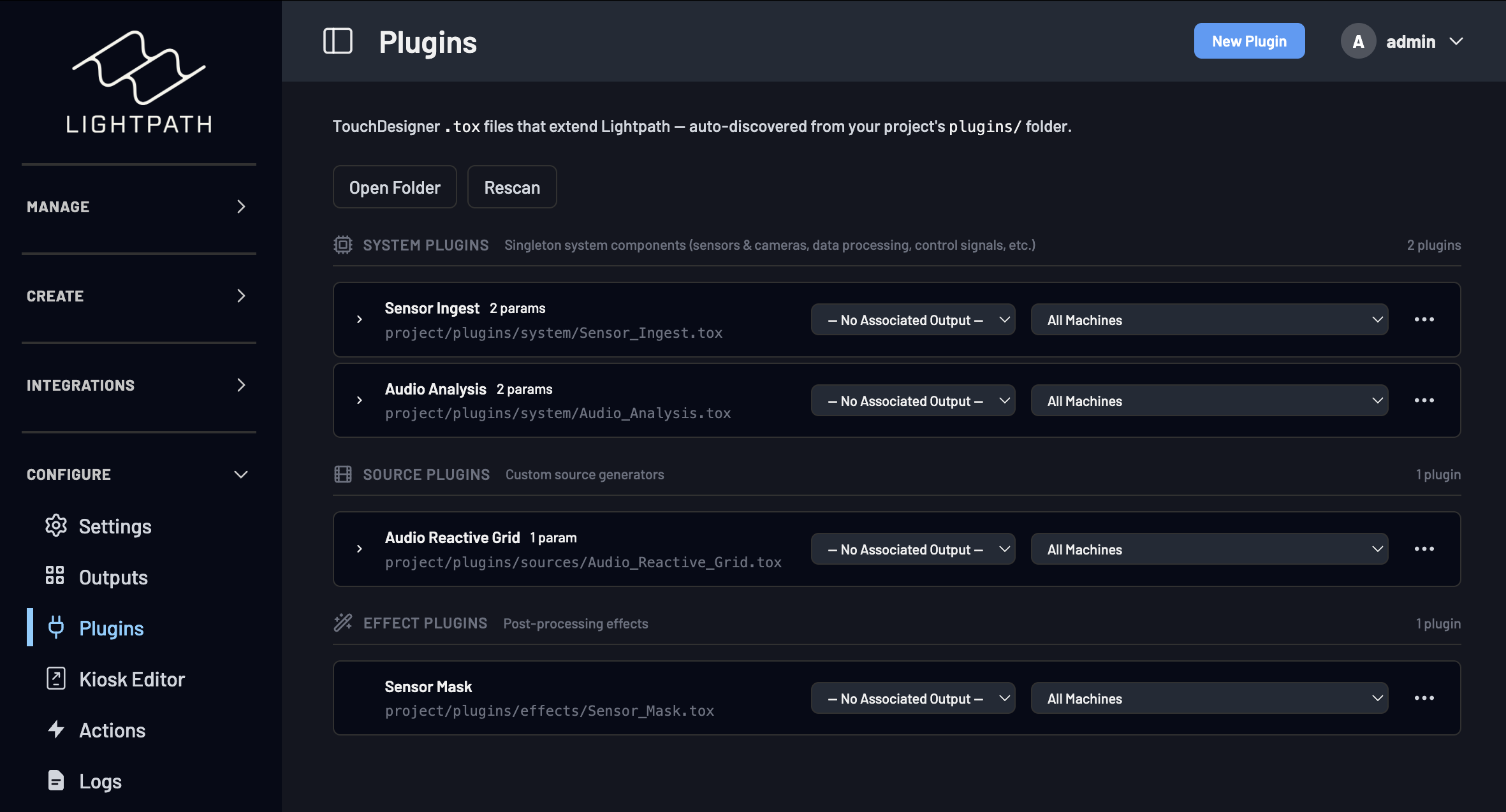
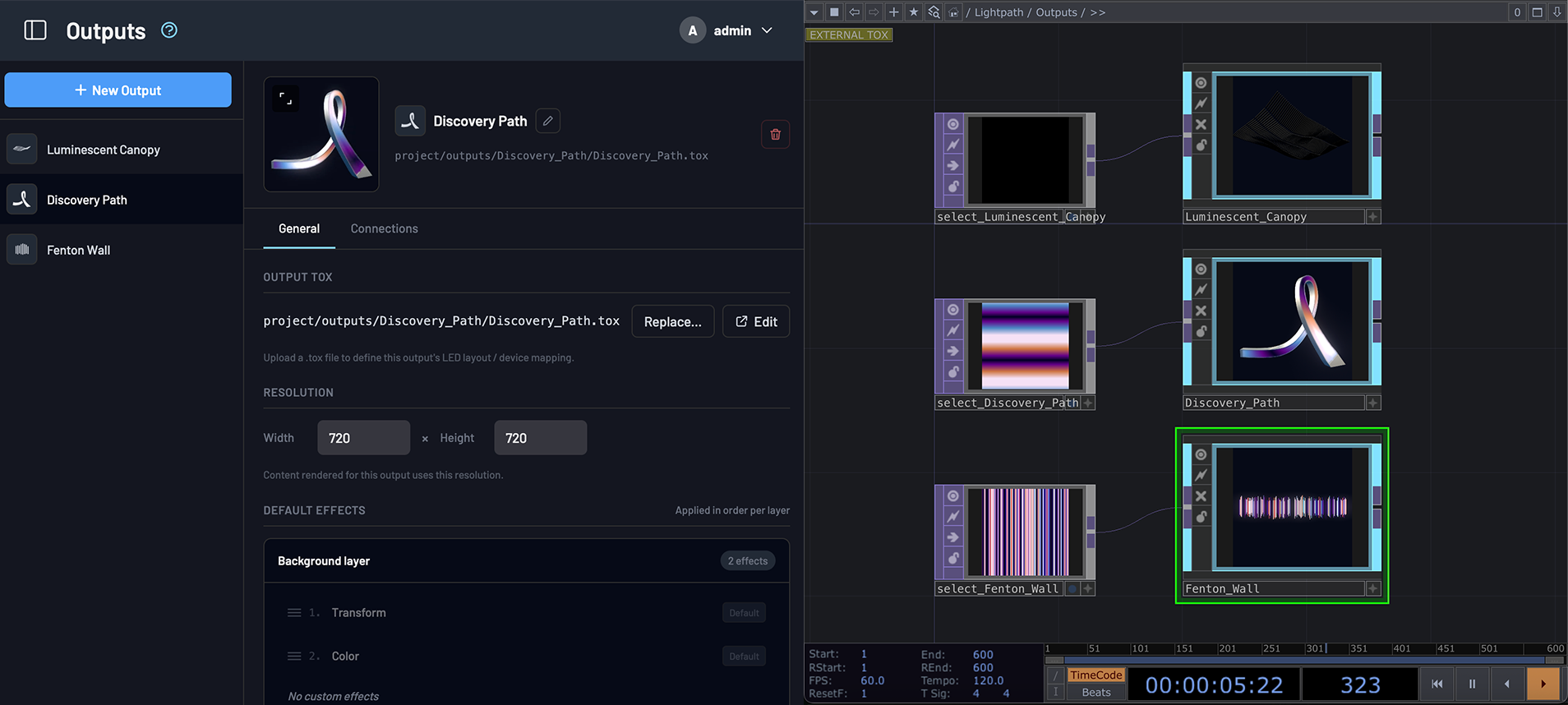
one .tox per physical endpoint (a pixel-mapped LED form, a projection surface, a video wall over NDI). Lightpath OS routes the composed texture to it and streams it back to the browser.
- 02
Plugins feed the outputs
Sources (generate texture), Effects (transform texture), System plugins (pull sensor/camera/API data, send control signals).
- 03
Parameters auto-surface
any param on a page named Look, Config, or Status appears in the web UI. Look = per-look (tuned in the look editor), Config = set once at project level, Status = read-only values that stream into the Devices view and can trigger alerts.
- 04
Real-time
TouchDesigner renders into Lightpath OS over Spout and takes control cues over OSC; Lightpath OS then streams the live pre-vis on to the browser.
What you get
-
Keep TouchDesigner's full power
any geometry, any hardware, any sensor.
-
Inherit the operational layer out of the box instead of rebuilding client UI, scheduling, and monitoring every time.
-
Survive the handoff
a shared, opinionated structure that stays maintainable years later.
-
Author content live in the browser with real-time pre-vis, approachable for people who never open TouchDesigner.
-
Multi-machine rendering plus process supervision and auto-recovery for years of uptime.
-
TouchDesigner is the shared language, so any TD developer is productive on day one.
Proof
“Out of that work came Lightpath, a web-based platform that wraps TouchDesigner in everything a permanent install needs to be handed off, operated, scheduled, monitored, and evolved over its whole lifespan.”
The Lagunitas Experience was built this way: custom C++ Ouster LiDAR ingest, a system plugin feeding it in, and custom sources generating content in real time.